
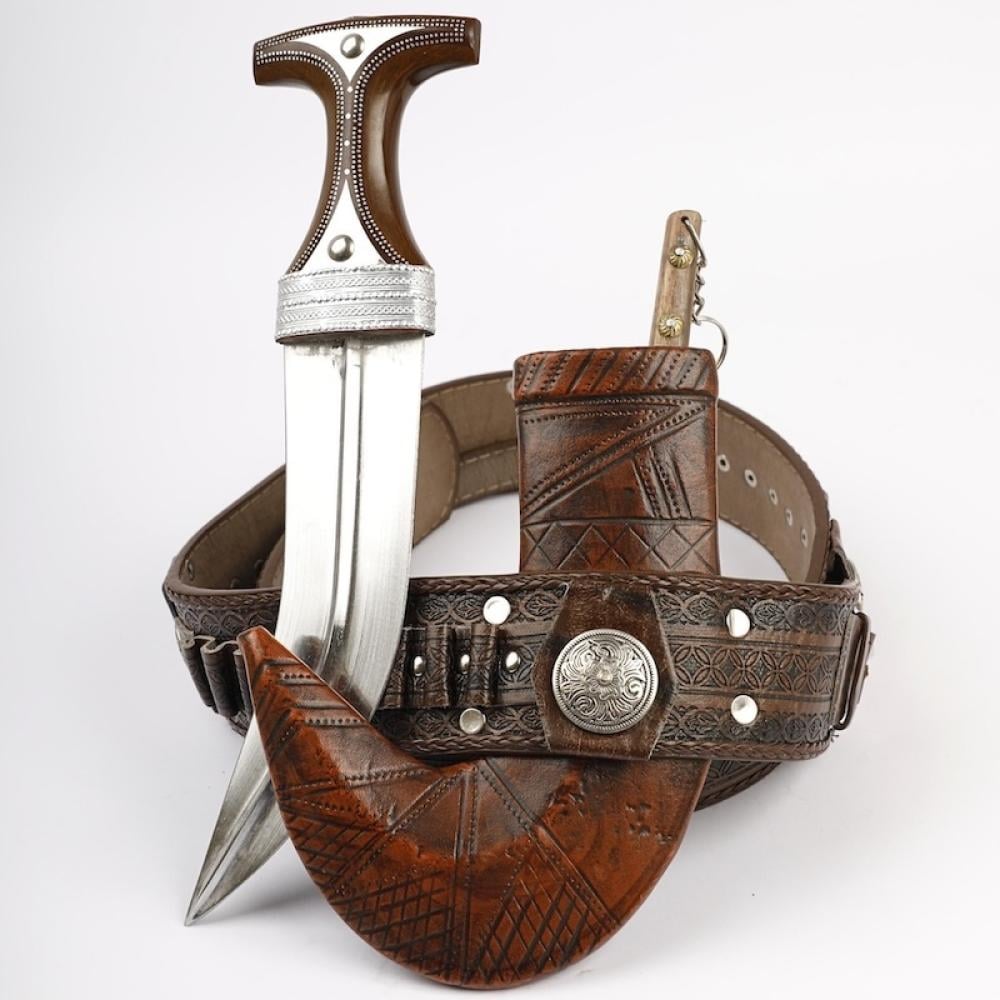

The jambiya: a symbol of authenticity and Arab heritage


The Jambiya: A rich history and a symbol of honor
The jambiya (plural: jamabi) is one of the most famous symbols of Arab heritage in southern Arabia. It is a curved dagger worn at the waist with a special belt. Throughout history, the jambiya has been associated with honor, manhood, and social prestige, and has become part of the cultural identity in large areas of Yemen and southern Saudi Arabia, particularly in Najran, Asir, and Jazan. It is also found in Yemen and Oman. ( Wikipedia )
History of the Jambiya
Archaeological evidence suggests that the jambiya is one of the oldest weapons known to humankind in southern Arabia, with historical inscriptions and statues dating back to the 8th century BC depicting men wearing jambiyas at their waists. Even older archaeological evidence highlights the importance of the dagger in ancient Yemeni civilizations. ( Wikipedia )
Over time, the jambiya (dagger) transformed from a tool for self-defense into a social and cultural symbol expressing status, identity, and tribal affiliation. ( Al Jazeera Net )
Components of the Jambiya
The traditional jambiya consists of several main parts:
1. The handle (head)
It is the most important and valuable part of the jambiya, and is made from various materials such as horn, silver, or wood. The value of the jambiya increases the rarer and higher quality the materials used for the handle. ( Wikipedia )
2. The blade
It is the sharp metal part, usually made of high-quality steel or iron, and is characterized by its well-known curve that gives the jambiya its unique shape. ( Wikipedia )
3. The sheath
A sheath protects the blade, often decorated with leather, silver, and beautiful traditional engravings. ( Al Jazeera Net )
4. The belt
Locally known in some regions as the belt or sling, it is used to secure the jambiya (dagger) around the waist. ( Wikipedia )
The dagger in Najran
The jambiya holds a special place in Najran's heritage, as it is an essential part of traditional men's attire. Men of the region wear it on national and social occasions, at weddings, and during heritage celebrations. It is worn alongside the thobe (long robe) and the Najrani turban, creating an appearance that reflects the rich cultural heritage of the region. ( alestiklal.net )
Uses of the jambiya
A symbol of heritage
Today, the jambiya has become more of a cultural and heritage symbol than a fighting tool.
Occasions and celebrations
It is worn at weddings, national celebrations and heritage festivals.
A symbol of social status
In the past, the jambiya (dagger) reflected its owner's status, social standing, and the quality of its craftsmanship. ( Wikipedia )
Jambiya making
The Jambiya between the past and the present
Despite modernization and changing lifestyles, the jambiya ( dagger) remains a prominent symbol of identity and heritage in southern Arabia. Today, it represents a history spanning thousands of years and stands as a testament to the authenticity of the Arab people and their pride in their cultural heritage. (Al Jazeera Net )
conclusion
The jambiya is not just a dagger worn at the waist; it is a story of history, identity, and heritage deeply rooted in the memory of generations. It has remained a symbol of pride and authenticity, reflecting the skill of the craftsmen and the rich traditions of the societies that have preserved it to this day. ✨
Najrani Jambiya, Najrani Jambiyas, buying a Jambiya, heritage Jambiya, silver Jambiya, handmade Jambiya, best Jambiyas, Najrani heritage, Najrani dress, traditional Jambiyas, southern Jambiya, Arabic Jambiya, popular shops.